In last week's
post, I noted that the two main sources of C02 emissions are Transportation and Electric Power Generation. Worldwide, Transportation accounted for about 20% of total CO2 emissions, and in the US it accounts for about 33%.
Concern about climate change and the rise in oil prices over the last 5 years partially explains the Ethanol
craze that has gripped policy-makers and the private sector. Last month's
State of the Union address was the second year in a row that Ethanol was the centerpiece of the President's "energy security" policy. In the U.S., the politics of ethanol is closely connected to corn subsidies. Unfortunately for all the talk about "energy independence", not enough advocacy is spent on climate change and conservation. In this post I'll try to give a brief overview of ethanol fuel in the U.S.
To start, we note that as the price of oil has gone down, ethanol futures prices have declined (graph
from the WSJ, subscription required):
 (To enlarge a particular image, click on it.)
 Conventional thinking asserts that in order for ethanol to take off among consumers, oil prices need to stay relatively high. On top of having to rely on high oil prices, ethanol fuel still relies on a slew of
goverment subsidies. With optimism in the industry at an all-time high, but with serious challenges still in place, there is growing
concern that the Ethanol sector is suffering from over-investment:
... These analysts see an analogy in the dot-com bust of 2000. The bust cleared out some of the worst ideas and least-efficient companies in the tech arena, allowing deeper-pocketed investors to consolidate operations and emerge leaner to make the Internet an even more powerful force in the world economy. ... "People will overextend and many plants will have financial difficulty," says Ricardo Leiman, Noble's chief operating officer. But he adds that as facilities fail, that could create more opportunities for bigger investors to move in. Of course, all bets are off if oil prices keep falling. If that happens, alternative energies could wither just as they did after the retreat of the oil-price surges of the 1970s.
Ethanol production, in the U.S. has been on a consistent
upward trend, and since 2000 it has really taken off. The year 2000 was when the EPA recommended that the fuel additive,
MTBE, be
phased out nationally:
 Brazil
 is the leading producer of fuel ethanol in the world, with 2nd place U.S. rapidly closing the gap. In the above graph, the U.S. data spans 1980-2005, while our data for Brazil spans 1982-2005. After Brazil and the U.S., 3rd place China produced about a quarter of what Brazil and the U.S. did in 2005. At a time when some analysts have pointed out that demand has yet to fully catch up with domestic production, imports are also
steadily rising (WSJ, subscription required):

With fuel ethanol production steadily rising, U.S. corn production is increasingly being diverted to ethanol:

As of 2006, 20% of corn production is used for ethanol: roughly equal to the amount of corn being exported overseas. The upward trend in the amount of corn used for fuel ethanol is unmistakable. In Brazil, estimates place the amount of sugar being used for ethanol at around 50-60%. Biofuel production is
starting to affect commodity
prices.
The main difference between
Brazilian and
U.S. ethanol lies in the feedstock used:

In the U.S. corn-based ethanol accounts for about 95% of total production, while Brazil relies almost entirely on sugar/sugarcane. The choice of feedstock determines the net energy produced:

The above
graph, produced by researchers in Brazil, estimates that ethanol made from sugarcane yields at least 8 times the amount of energy used to produce it, while corn ethanol only yields about 1.6 times. Some
prominent researchers have published papers suggesting that corn-based ethanol actually "... requires 29 percent more fossil energy than the fuel produced". Recently, a team from UC Berkeley reviewed six representative studies, and
concluded that:
Studies that reported negative net energy incorrectly ignored coproducts and used some obsolete data. All studies indicated that current corn ethanol technologies are much less petroleum-intensive than gasoline but have greenhouse gas emissions similar to those of gasoline. (from the Journal Science, January 2006)
What the Berkeley team found after reviewing data from several research studies was while
corn ethanol had a slightly positive energy output, in terms of greenhouse gas emissions it is not much of an improvement over gasoline. Their best estimates suggest that Corn Ethanol leads to a mere 18% reduction in emissions, unless current production methods become cleaner. For
Cellulosic Ethanol, their calculations change drastically: they found that switching from gasoline to Cellulosic Ethanol led to a 90% reduction in greenhouse gas emissions. The US Department of Energy
estimates that Cellulosic Ethanol yields about 2.6 times the amount of energy used to produce it. In a future post, I will discuss another promising alternative: bio-diesel.
Based on energy yield and reduction in greenhouse emissions, Cellulosic or Sugarcane Ethanol are clearly more desirable than Corn.
Sugarcane ethanol imports from Brazil are rising, and local producers of corn ethanol are actively lobbying for the
continuation of import tariffs.
Cellulosic ethanol is
not yet being produced on a commercial scale. Although there is
growing excitement about the prospects of Cellulosic Ethanol, ethanol in the U.S. will, at least over the next several years, be primarily derived from Corn.
Corn Ethanol has a lot of boosters:
 Corn subsidies
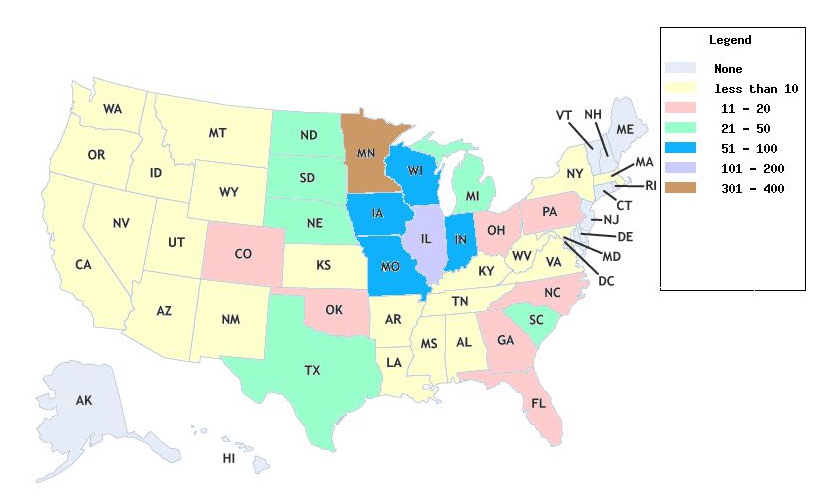
 are a staple of American politics. In 2005, $9.4B in subsidies went to geographic areas that also happen to be important "battleground" states:

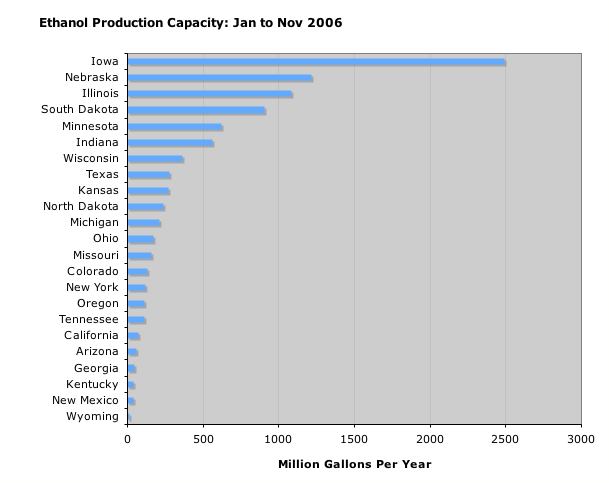
Iowa (earliest presidential primary), Illinois (home of Barack Obama), and the swing states of MN, OH, WI, MO, MI received substantial percentages of the 2005 corn subsidies. It is safe to assume that Corn ethanol will be heavily promoted over the next few years. In fact, the Corn lobby is already starting to
push back against imported Sugarcane ethanol:
... With all that guaranteed demand, more than makers of corn-based ethanol could ever meet, one might think there was no longer any need for the 51-cent-a-gallon tax credit for ethanol, which will cost taxpayers about $2.6 billion next year and more in later years as ethanol production rises. One might also think that, since the goal is to "diversify" the U.S.'s energy sources, there is little reason to continue a 54-cent-a-gallon tariff on imports of sugar-derived ethanol from Brazil.
... The reason has little to do with economics, and a lot to do with the politics of corn. The tax credit was born during the oil-price spike of 1978; the tariff was added to prevent foreign producers from getting U.S. subsidies. The two measures sustained an embryonic ethanol industry in corn-growing states when oil prices were low and there wasn't much government, consumer or Wall Street interest in alternative fuels.
Times have changed, but the folks who benefit don't much like the idea of repealing the credit or tariff. And they have a lot of friends in the Senate -- including Charles Grassley of Iowa, the top Republican on the Senate Finance Committee -- and among presidential candidates, for whom ticking off Iowa's corn farmers would be an exercise in masochism.
Finally,
conservation should be an important component of any energy policy. While fuel efficiency is frequently mentioned, over-consumption is hardly ever raised. In an economy heavily dependent on consumer spending, we may have to start using less fuel:
... not only are there more people in the U.S., but each one of them burns through much, much more oil. Americans burn through 27 barrels of oil annually per capita, six times and change more than the Brazilians' 4.2 barrels. The U.S. produces more oil per capita, too -- 11 barrels to Brazil's 3.35 barrels. And the gap between production and consumption in the U.S. is a gaping 16 barrels per person per year, while Brazil's gap amounts to just 0.85 barrels.
In
2004, the U.S. consumed 44% of total gasoline worldwide! If California were a separate country, it would have ranked 2nd in terms of total consumption:

In a
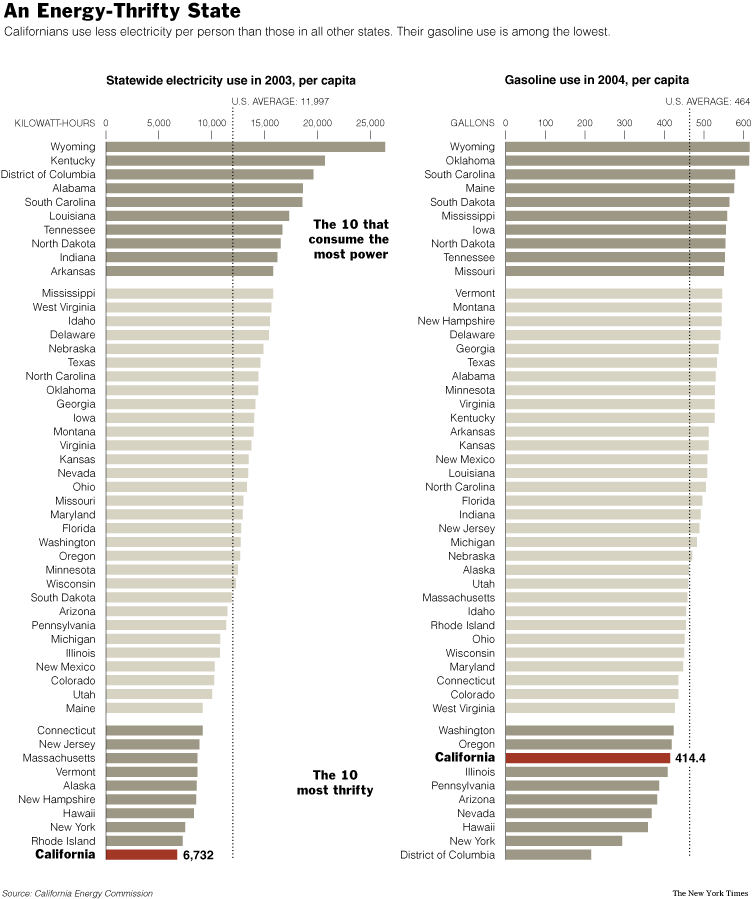
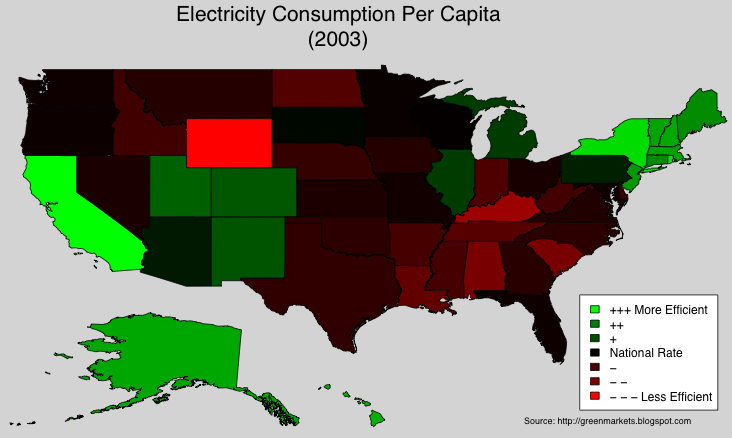
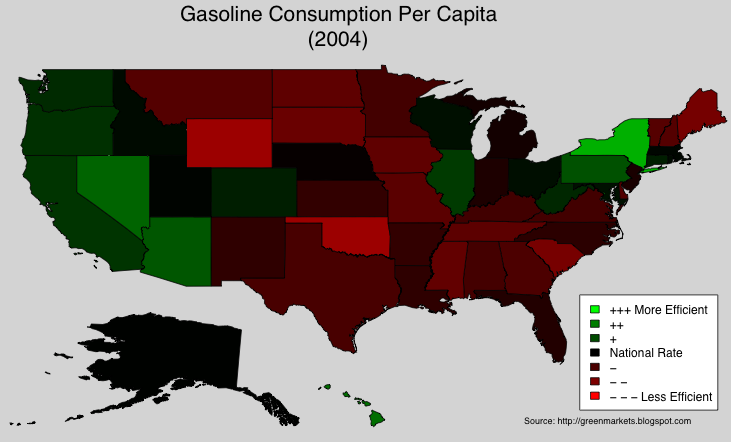
previous post, I noted that California is actually among the states which use the LEAST amount of gasoline, on a per capita basis.
China and
India are large countries whose consumers are starting to embrace the automobile. The recent UN report on climate change linked human activity to gloabl warming, fortunately, it comes at a time when the two most populous countries are starting to fall in love with motor vehicles. To show some leadership on this issue, the U.S. needs to reduce its net gasoline consumption. But conservation is not something that either the Democrats or Republicans are willing to talk about. The outlook is especially bleak over the next two years. In comparison,
Corn ethanol has no shortage of advocates.
Paul Krugman observes:
... Subsidizing ethanol benefits two well-organized groups: corn growers and ethanol producers (especially the corporate giant Archer Daniels Midland). As a result, it's bad policy with bipartisan support. For example, earlier this month legislation calling for a huge increase in ethanol use was introduced by five senators, of whom four, including presidential aspirants Barack Obama and Joseph Biden, were Democrats. In a recent town meeting in Iowa, Hillary Clinton managed to mention ethanol twice, according to The Politico. Meanwhile, conservation doesn't have anything like the same natural political mojo. Where's the organized, powerful constituency for tougher fuel economy standards, a higher gasoline tax, or a cap-and-trade system on carbon dioxide emissions? Can anything be done to promote good energy policy? Public education is a necessary first step, which is why Al Gore deserves all the praise he's getting.
UPDATE (3/19/2007):
Business Week chronicles the growing opposition to corn-based ethanol.
UPDATE (3/26/2007): The Washington Post has
an article and an
online chat on problems with corn-based ethanol.
Digg It! , Bookmark to del.icio.us