Sicko may be Michael Moore's best film yet, but I do not agree with him that a single-payer system is the way to go. Both the UK and France have a mix of public and private healthcare providers, while Canada is the poster child of a single-payer system. Interestingly short films to counter Sicko are starting to appear on YouTube, and organizations like Timely Medical Alternatives are being cited by opponents of a single-payer system.
Moore cites the postal service and the school system as examples of where the government plays a large role, and concludes that the medical system is too important to leave to private entities. While I use the US Postal Service 90% of the time, I do like having the choice of using UPS or FedEx when I want to really track my packages (the US Postal Service tracking pales in comparison). Similarly, some parents prefer sending their kids to private educational institutions. Politically speaking, it is easier to sell a system that gives people choices.
Ideally we make Medicare available to anyone who wants it, and let the HMO's compete with Medicare. The competition will make both systems more "customer friendly" and we all benefit from having a responsive system. I think most people will opt to use the Medicare system for all but a few of their needs, while some people will opt to go with HMO's completely.
The devil is in the details of course. To lower costs, the US system needs to streamline its Information Technology and billing/claims systems, have meaningful TORT reform to lower malpractice insurance, lessen the grip of the AMA and allow foreign trained family doctors an easier path towards practicing in the U.S., allow Medicare to negotiate directly with pharma, etc. These recommendations alone imply going against lobbyists representing lawyers, doctors, and big pharma! Perhaps electoral reform (i.e. public financing of elections, instant runoff, etc.) is the necessary first step to have any meaningful shot at getting things done. Hmmm, electoral reform sounds like the perfect topic for the next Michael Moore film :-)
At the end of the day, any national healthcare system has to scale to 300M people, and still pay for itself. Tax increases may need to be part of the equation. Immigration reform will need to be enacted: the U.S. has legal and illegal immigrants on a scale that other developed nations would have a hard time absorbing.
Most importantly, as Michael Moore points out, there needs to be an adjustment in attitude in the U.S. We need to go " ... from a nation of me's, to a nation of we's".
Digg It! , Bookmark to del.icio.us , My Yahoo! , ATOM Feed
Showing posts with label health. Show all posts
Showing posts with label health. Show all posts
Tuesday, July 03, 2007


Tuesday, May 22, 2007
Occasional Dimes: Memorial Day Edition
Digg It! , Bookmark to del.icio.us , My Yahoo! , ATOM Feed
Monday, December 18, 2006
Healthiest Regions in the U.S.
It is not hard to see why Green Entrepreneurs might be interested in public health studies. Organic products + love for the environment and outdoors + interest in wellness and healthy living, definitely helps raise the health of any community. The important LOHAS market segment can help nurture products and technologies which could have huge public health benefits.
So what are the healthiest regions int the U.S.? The United Health Foundation conducted a study in 2004, where they measured states along several variables and ranked them using a composite index. To visualize the results, I took the data and generated a heat map. Green signifies a State scored higher than the 50 State average, Red signifies the State scored lower, Black means the State scored about the same as the 50 State average. (To enlarge a particular image, click on it.)
 MN finished first: a position it has held 9 out of the last 15 years. NH, VT, HI and UT roundup the top five states. States in the Southeast consistently scored below the 50 State average. I have heard factoids that the Southern states lag the rest of the country in terms of income levels. But I have to admit the map still surpised me. These red colored states await Green Entrepreneurs and solutions.
I wanted to "drill-down" into major cities in each state, but alas, I was unable to find data at the city level. Wanting "city-level" data, I decided to look at this ranking of the 50 largest U.S. cities, put together by a different organization (Centrum). Actually, Centrum ranked Metro Areas (or SMSA's), and they used the 2003 estimated population to come up with the 50 largest. Just like any "ranking" or "survey", this one has it's flaws, but Centrum was quite transparent about the data sources and metrics used in the study. The data came from mostly public sources. In coloring a specific Metro Area, I included counties that are part of the Metro Area: in some instances this might show Metro Areas crossing state lines.
The Overall Score and Ranking, is based on a weighted composite scores across several dimensions. (To enlarge a particular image, click on it. Feel free to use these maps.)

I thought the scores in the individual dimensions were interesting. For each dimension, the average score is equal to the (percentile) median: 50.
Mental Wellness was based on the following criteria.

I see that the West Coast is a prime market for stress relief solutions. Washington, DC scored the highest -- but they mean the residents of DC and not Congress!
Lifestyle Pursuits was based on the following criteria.

One can argue with the choice of "lifestyle pursuits" calling into question the stability of the results: different "lifestyle pursuits" would probably result in a very different map.
Physical Activity was based on the following criteria.
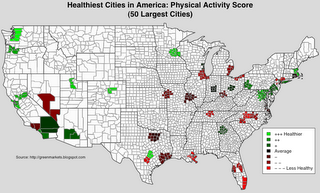
L.A. and South Florida finished lower than I expected: that blows our beach culture stereotype. Miami finished near the bottom. If they included Yoga, L.A. would be bright green!
Health Status was based on the following criteria.

These results seem to coincide somewhat with the State rankings above. Michigan which has finished #1 in the Unite Health rankings for 9 out of the last 15 years, is represented by Detroit, which is near the top in this metric.
Nutrition was based on the following criteria.
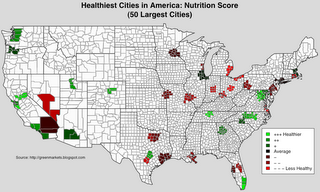
The Northern states fared poorly, possibly due to higher alcohol consumption and lack of year-round access to fresh fruits and vegetables.
Summary: The non-profit United Health Foundation's State Health rankings reveals opportunities for Green Entrepreneurs and activists based in the Southeastern states. Drilling-down to Metro Areas, I was unable to find city-level data from United Health, and turned to Metro Area rankings from a separate study.
So what are the healthiest regions int the U.S.? The United Health Foundation conducted a study in 2004, where they measured states along several variables and ranked them using a composite index. To visualize the results, I took the data and generated a heat map. Green signifies a State scored higher than the 50 State average, Red signifies the State scored lower, Black means the State scored about the same as the 50 State average. (To enlarge a particular image, click on it.)
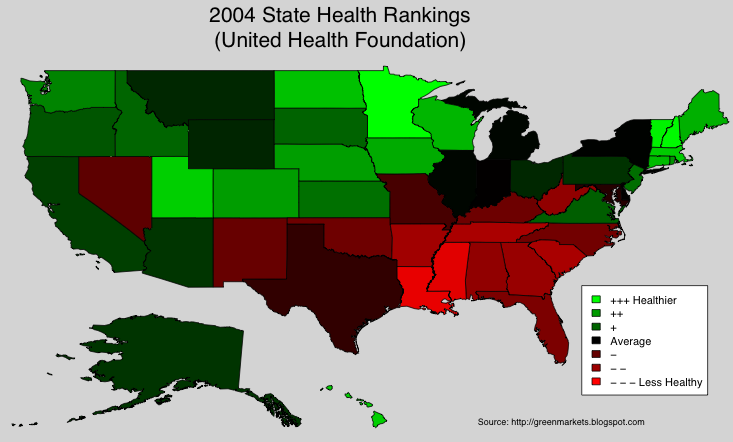 MN finished first: a position it has held 9 out of the last 15 years. NH, VT, HI and UT roundup the top five states. States in the Southeast consistently scored below the 50 State average. I have heard factoids that the Southern states lag the rest of the country in terms of income levels. But I have to admit the map still surpised me. These red colored states await Green Entrepreneurs and solutions.
I wanted to "drill-down" into major cities in each state, but alas, I was unable to find data at the city level. Wanting "city-level" data, I decided to look at this ranking of the 50 largest U.S. cities, put together by a different organization (Centrum). Actually, Centrum ranked Metro Areas (or SMSA's), and they used the 2003 estimated population to come up with the 50 largest. Just like any "ranking" or "survey", this one has it's flaws, but Centrum was quite transparent about the data sources and metrics used in the study. The data came from mostly public sources. In coloring a specific Metro Area, I included counties that are part of the Metro Area: in some instances this might show Metro Areas crossing state lines.
The Overall Score and Ranking, is based on a weighted composite scores across several dimensions. (To enlarge a particular image, click on it. Feel free to use these maps.)
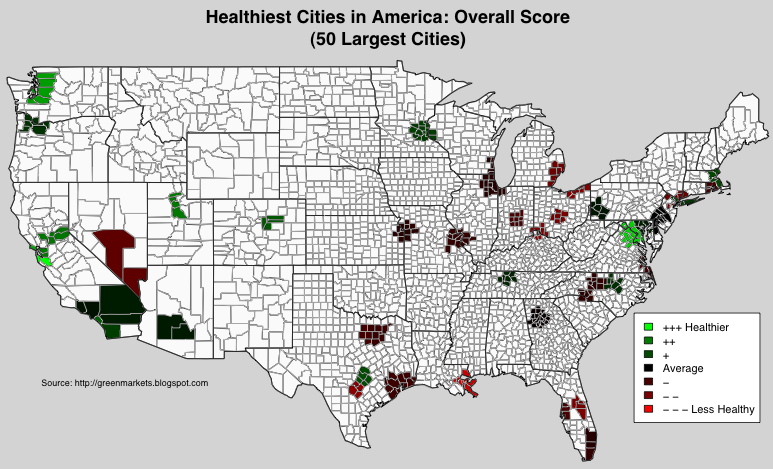
I thought the scores in the individual dimensions were interesting. For each dimension, the average score is equal to the (percentile) median: 50.
Mental Wellness was based on the following criteria.
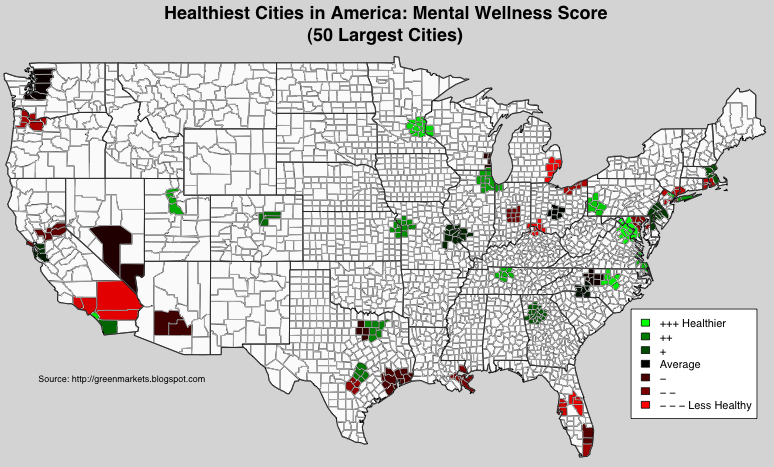
I see that the West Coast is a prime market for stress relief solutions. Washington, DC scored the highest -- but they mean the residents of DC and not Congress!
Lifestyle Pursuits was based on the following criteria.
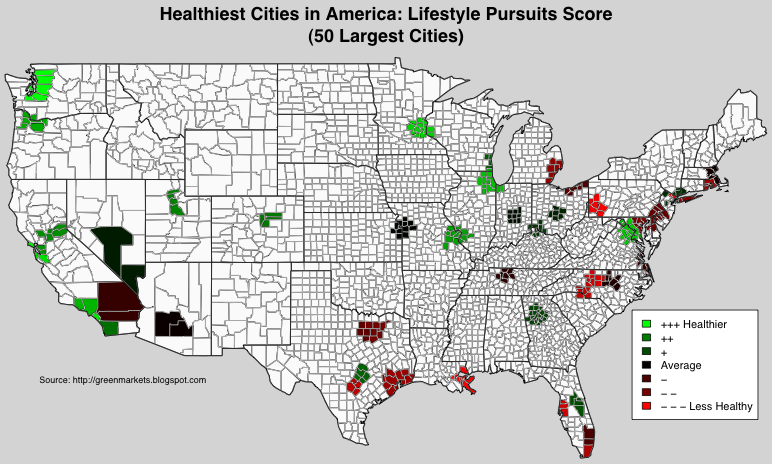
One can argue with the choice of "lifestyle pursuits" calling into question the stability of the results: different "lifestyle pursuits" would probably result in a very different map.
Physical Activity was based on the following criteria.
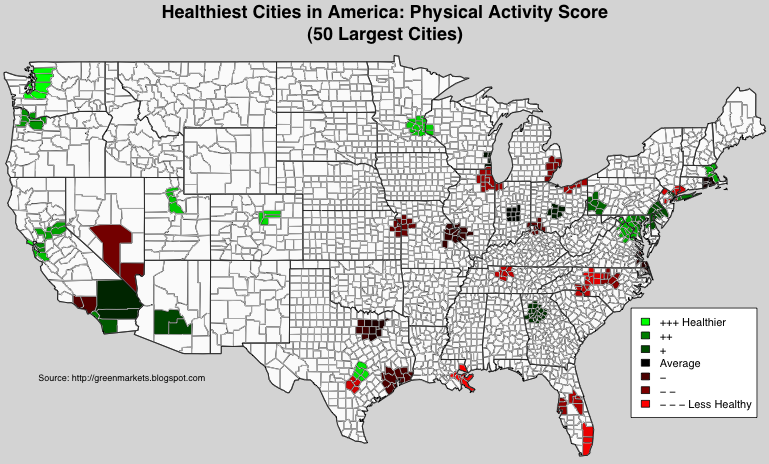
L.A. and South Florida finished lower than I expected: that blows our beach culture stereotype. Miami finished near the bottom. If they included Yoga, L.A. would be bright green!
Health Status was based on the following criteria.
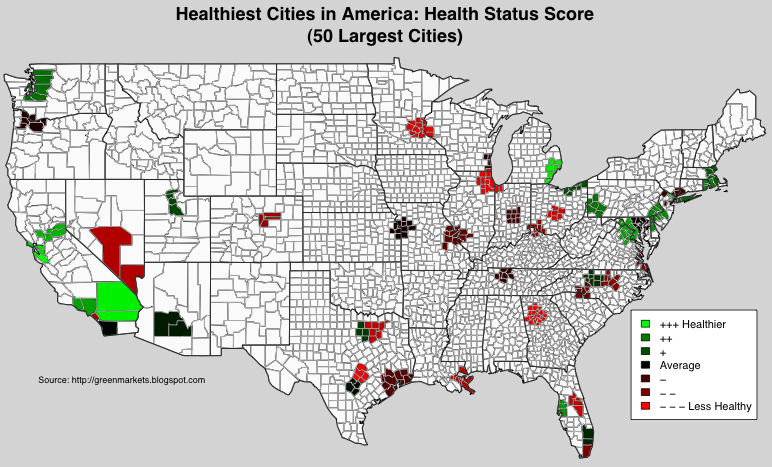
These results seem to coincide somewhat with the State rankings above. Michigan which has finished #1 in the Unite Health rankings for 9 out of the last 15 years, is represented by Detroit, which is near the top in this metric.
Nutrition was based on the following criteria.

The Northern states fared poorly, possibly due to higher alcohol consumption and lack of year-round access to fresh fruits and vegetables.
Summary: The non-profit United Health Foundation's State Health rankings reveals opportunities for Green Entrepreneurs and activists based in the Southeastern states. Drilling-down to Metro Areas, I was unable to find city-level data from United Health, and turned to Metro Area rankings from a separate study.
Subscribe to:
Posts (Atom)

