Showing posts with label clean coal. Show all posts

Wednesday, July 11, 2007

Externalities: Coal and Wind Energy

In a recent post, I highlighted mining and extraction costs ("externalities") associated with coal mining. In most countries coal is the dominant source of electricity. To effectively compete with the de facto source of electricity, supporters of renewable energy need to understand some of the externalities that are usually omitted when calculating the average cost of electricity from coal.


"Clean coal" initiatives do address emissions, but as I argued in my earlier post, mining and extraction have not been accounted for in a systematic manner.

On the emissions side, the most famous study on particulates was the decade-long EU study, ExternE ("the external costs of energy"):
Human activities like electricity generation or transport cause substantial environmental and human health damages, which vary widely depending on how and where electricity was generated. The damages caused are for the most part not integrated into the pricing system. Borrowing a concept adopted from welfare economics, environmental policy calls these damage costs externalities or external costs. By societal welfare principles, policy should aim to ensure that prices reflect total costs of an activity, incorporating the cost of damages caused by employing taxes, subsidies, or other economic instruments. This internalisation of external costs is intended as a strategy to rebalance the social and environmental dimension with the purely economic one, accordingly leading to greater environmental sustainability.
Thanks to the EU! Given the current level of influence of energy industry lobbyists in Washington, it is hard to imagine an equivalent Federal study being funded in the US. Nevertheless, US scientists have used the results of ExternE to estimate additional costs in the US.

Coal and Air Pollution
In what follows, we examine the costs due to particulates and air pollution ONLY: we do not include Mining (Environmental) and CO2 (Global Warming) costs. First an overview of the public health problems associated with particulates and air pollution (Williams, 2004):
... In recent years health damages, especially from chronic exposure to small particle air pollutants has been a focal concern about air pollution. Recent epidemiological research indicates major mortality impacts from long-term, low-level exposure to particulates — both particles emitted directly in combustion and sulfate and nitrate particles formed in the atmosphere from gaseous precursor emissions of SO2 and NOx. Lippman and Schlesinger (2000) survey the recent literature, concluding that the correlation of ambient particulate exposure levels commonly found in U.S. cities with increased human mortality and morbidity remains robust to all attempts to identify possible confounding variables.

... It is estimated that those in the US who have died from exposure to PM2.5 air pollution particles had their lives shortened, on average, by 14 years. ... the EPA projects that the Clean Air Act Amendments of 1990 will reduce the US death rate in 2010 by 23,000/y (EPA, 1999). But even with these laws in place, the premature death rate associated with residual small particle air pollution is significant. For example, Abt (2002) projects 6,000 premature deaths from emissions from 80 U.S. coal-fired power plants in the year 2007 (even accounting for new control technologies mandated by that year). These recent findings translate into much higher costs for air pollution damages than was the case for studies before chronic mortality impacts were taken into account.
Williams takes the ExternE results, and adapts them to regions in the US. In the graph below, he compares different typed of coal generation plants to Natural Gas Combined Cycle (NGCC) plants:


What the graphs says is that a clean coal plant is 50% more expensive than a comparable NGCC plant: for an NGCC plant the approximate cost for these externalities are about 40 cents/MWH. For the average coal plant, the externalities were 84 times more than an NGCC plant. Assuming coal is here to stay, at least for a long while, the public health implications of not switching to cleaner plants are immense! If the market were to price in the cost of these externalities, these older coal plants would be so much more expensive than renewables, they would have to be shut down.

In the US, the reality is sadly as follows: The older coal plants were built years ago so their construction costs are fully paid for. Utilities who own these plants know that newer, cleaner plants would be much more expensive to build. Similarly, retrofitting older plants would cost serious money. A few million dollars spent on lobbying against clean air standards is peanuts, so the industry seems intent on devoting more resources to lobbying.

ExternE and Wind Energy
How does wind energy score on the ExternE study?


Wind was the cheapest on both greenhouse gas and air pollution costs. Deployed clean coal technologies are still costly when it comes to greenhouse gas impacts. How does this translate into the cost (per KWH) of electricity?


Graphing the results for the UK and for Denmark:


reveals a different economic picture from what I portrayed in a previous post. In a future post, I will readjust those earlier cost graphs.

Digg It! , Bookmark to del.icio.us , My Yahoo! , ATOM Feed


Tuesday, June 19, 2007

The True Cost of Coal

As far as electricity generation is concerned, Coal is the benchmark against which all renewable energy sources are compared with. In a previous post, I compared the cost per kilowatt hour (KWH) from a variety of renewables and concluded that coal is still much cheaper. In this post we will evaluate coal using the Triple Bottom Line and conclude that it is clearly a lot more expensive than it seems. It is important to evaluate the cost of coal more realistically before the developing world builds even more coal-powered generation plants.

In thinking about coal, it is useful to separate the problem into two pieces: mining and extraction, and electricity generation. In a previous post, I examined technologies for coal-powered electric plants that use sequestration to ensure that emissions are captured and stored underground. None of the touted "carbon sequestration" or "clean coal" technologies have been deployed in a commercial plant and doing so would naturally add to the cost per KWH.

The cost of mining and extraction is where traditional accounting falls short. First off, how is coal extracted?
... Early coal mining was almost exclusively done in deep shafts that led to thick (5-10 feet) coal seams, which were blasted and picked out and loaded on rail cars to be drawn out of the mine by mules. Miners worked in dark, dusty conditions always at the risk of fatal roof falls and methane gas explosions. Beyond the risk of sudden death or serious injury, miners also faced the prospect of black-lung disease if they spent years in the profession.

Deep mining has indeed come a long way. Today, miners use a technique called long-wall mining, which involves a long (up to a mile) face of an underground coal seam which is dislodged by a saw that runs on tracks along the face. This method is much more efficient at removing thick coal seams than the old blast-and-pick method, and accounts for half to two-thirds of current Appalachian coal production. While some dangers are now less, current underground mining still results in fatal roof fall and explosion accidents.

Surface mining, or strip mining, has become more and more popular in recent decades, especially in removing thinner seams of coal (as little as a foot thick). The most recent innovation in strip mining is known as mountaintop removal. It peels back a mountain, layer by layer, by alternately blasting the thick layers of rock away from the coal seams and then scraping the coal seam out and hauling it away in huge dump trucks. Much of the “overburden” rock (the non-coal layers) is pushed off into adjacent valleys. As much as 500- to 1,000-vertical feet of a mountain may be removed in the process and valleys are filled in to depths of as much as 500 feet by the rubble.
The current approaches involve either removing entire mountain tops or dislodging mile-long underground seams! Unless the mining companies are voluntarily estimating the cost of these forms of environmental degradation, the cost of electricity from coal as quoted in media reports, is not accurate. The list of environmental problems associated with coal mining is depressing. Here is one I ran across from the Union of Concerned Scientists:
MINING
Altered landscapes. Surface mining in Appalachia often removes entire mountaintops and dumps the wastes into valleys and streams; between 1985 and 2001, more than seven percent of the region's forests were cut down and more than 1,200 miles of its streams buried or polluted. In addition, waste materials from underground mining are placed in large piles above ground, which can also scar the landscape and alter stream flow.

Water contamination. Acids and toxic metals can contaminate surface and groundwater, harming aquatic life and rendering water supplies undrinkable.

Safety hazards. Underground mining accidents result in many deaths and injuries, and coal dust inhalation causes chronic health problems. Black lung disease still kills about 1,000 former coal miners in the United States each year.

PREPARATION
Water contamination. Impurities such as acids and heavy metals removed from coal and stored in slurry reservoirs canleach into surface and groundwater.

Safety hazards. Slurry reservoir dams can fail, flooding local waterways and putting both wildlife and downstream communities at risk.
The main problem with both mountain top removal and long-wall mining is that landscapes are permanently altered as a result of coal mining:
... The coal in the Appalachian Mountains is hard to extract because it is buried under layers of shale and sandstone hundreds of feet thick. A few decades ago, strip miners would cut along the edge of a ridge side, then auger into a coal seam. But today, with bigger machines and little moral or regulatory constraint, coal operators simply blast away the entire mountaintop -- its forests, capstones, and topsoil -- so they can scrape out thin seams of low-sulfur coal. Nearly everything else is dumped into the valleys below, often burying pristine headwater streams. The resulting "valley fills" create the largest man-made earthen structures in the country -- huge treeless funnels that let mud and rainwater wash unimpeded through low-lying communities all across central Appalachia. The town of McRoberts, Kentucky, recently endured three "100-year floods" in 10 days. The water filled homes and carried away carports. When TECO Energy of Tampa, Florida, had leveled every peak around the community, it took the coal, took the profits, and left the people of McRoberts with crumbling homes, terrible roads, and a constant fear of being washed away in one’s sleep.

According to the Environmental Protection Agency, in addition to the more than 700 miles of streams buried by valley fills, thousands more miles have been contaminated with sediment, heavy metals, and acid mine drainage, a toxic orange syrup that kills everything in its path. And these are headwaters, so their contamination affects all life downstream. In Letcher County, Kentucky, children suffer extremely high rates of diarrhea, vomiting, nausea, and shortness of breath, all of which can be tied to dissolved minerals in nearby streams. Presumably the Clean Water Act was established to prevent such degradation. But early in the Bush administration, coal lobbyist Steven Griles was named a deputy secretary at the Department of Interior. Officials changed one word of the act -- replacing "waste" with "fill" -- so that toxic mining debris could be dumped into rivers as benign fill material.

There will soon be enough flattened mountaintops in Appalachia -- 1.4 million acres -- to set down the state of Delaware on former summits. Try driving across the 10,000-acre wasteland that surrounds Larry Gibson’s home on Kayford Mountain, West Virginia. Hundreds of people, like the photographer J. Henry Fair, make that trip every year to see, in Gibson’s words, "what hell looks like." Kayford Mountain, more than any place I know, illustrates the power and the willingness of some human beings to convert the natural world into money and "cheap energy" as quickly as possible. If that means the total destruction of an entire region, its people, and its culture, so be it.

And yet the majority of Americans have never heard of mountaintop removal.
One may be able to clean up coal-powered plants, but can one mine for coal without destroying the environment? Coal isn't as cheap as it appears, if anything the true cost of mining it probably makes it one of the most expensive energy sources. Using the Triple Bottom Line (People, Planet, Profits), coal costs a heck of a lot more than renewable energy sources.

Summary
Coal is touted as the cheapest source of (abundant) energy around, and in this post I argue that coal is actually quite expensive. From a power generation and emissions perspective, will "clean coal" and "carbon sequestration" be as cost-effective as current renewable energy sources? No commercial plants have been deployed so cost estimates are mere guesses at this point. Given the growth in coal usage in China and India, developing "clean coal" power plants is extremely important.

More importantly, Coal is cheap because the environmental costs of mining and extraction are more or less ignored. How cheap would coal mining be if it were held to the standard that it should be?

Hopefully the current excitement surrounding renewable energy, plus a heavy dose of energy efficiency and conservation will lead to less coal in the future.

Digg It! , Bookmark to del.icio.us , My Yahoo! , ATOM Feed

Monday, February 12, 2007

Coal and Electric Power Generation

In an earlier post, I noted that Electric Power Generation was the largest source of CO2 emissions: in the U.S. it accounts for about 40% and worldwide about 38%. This week I'll review the main sources of electric power, some technologies being developed to clean up power generation, and the political challenges that lie ahead. As in previous weeks, I'll argue that while technological developments are vital, the U.S. needs to show leadership in the area of conservation. While the developed world may be slowly waking up to the threat posed by climate change, we need to lead by example and demonstrate to the emerging economies of India and China, that conservation need not translate to slower economic growth.

Electric Power Generation
How does the U.S. generate electricity? Unfortunately, half of the total electric power generated still comes from coal:

(To enlarge a particular image, click on it.) Renewables accounted for a mere 2%! But at least Renewables have grown the fastest, right? Actually, Natural Gas is the fastest growing source of Electricity, while the growth in Renewables was just on par with the growth in Nuclear and Coal:

Does the importance of Coal in the Electric Utility sector explain why the U.S. has not signed on to the Kyoto Protocol? The OECD countries (Europe + North America + Japan + Korea + Austalia +NZ) collectively, rely less on Coal:

Meanwhile, the two most populous countries and their surging economies, are even more heavily dependent on Coal:

Close to 80% of all electricity in China is generated from Coal! But with China (and India) one always needs to factor in their pace of growth. Warning, the statistics cited below are mind-blowing:
China’s soaring economic growth has been headlined in recent years by a single, attention-grabbing statistic: China each year adds new power generating capacity equal to the UK’s entire electricity grid. But China surpassed this benchmark last year, according to new figures released quietly at the end of January by the China Electric Power News, the mouthpiece of the state industry. The paper reported that new power capacity in 2006 had expanded by 102 gigawatts, or roughly equal to the entire capacity of the UK and Thailand combined, or about twice the generating assets of California, the state with the biggest economy in the US.
... Just less than 90 per cent of the new plants are powered by coal, an inevitable result of a rapid build-up in capacity. Hydro power accounted for 10 per cent and new nuclear plants about 1 per cent.
Even if the share of Coal drops to 50% in both China and India, which would be remarkable given their current dependence on coal, their growth rates translates to a lot more Coal powered utility plants over the next decade.

Based on the numbers above, Coal will be a major source of electricity for years to come. More environmentalists are realizing that eliminating coal completely is a difficult proposition:
Like it or not, a future without coal is politically implausible in the near term, says David Hawkins, director of the climate program at the Natural Resources Defense Council: "While as a technical matter we could run the world's economy without coal, as a political matter it is not going to happen fast enough. The fuel's abundance and low cost make it something that most political leaders are unwilling to give up. We must do everything we can to accelerate our use of renewables, but the renewable-energy future is far too slow in coming to put all our eggs in that basket," Hawkins argues. "We have to start reducing greenhouse gases before we phase out fossil fuels."
The problem at least appears manageable: install technology at the Electric Utilities to reduce or eliminate emissions. While one need only deal with a fixed number of locations, it still requires technologies that are expensive to develop and deploy. The U.S. will most likely be at the forefront of "Clean Coal" technologies. America is the "Saudi Arabia of Coal", with 27% of all known coal reserves, and Business Leaders in the U.S. are starting to see the business potential of "Clean Coal".

Clean Coal and Carbon Sequestration
What exactly is "Clean Coal"? To address that question, we need to understand some basic facts about coal. Besides generating CO2 emissions:
... coal is as filthy as it is cheap and abundant. When burned it releases three pounds of sulfur dioxide and four pounds of nitrogen oxide for every megawatt-hour of operation. The nation's plants produce a total of about 48 tons of mercury annually.
One promising form of Clean Coal is:
... integrated gasification combined cycle—a mouthful usually shortened to IGCC. Unlike conventional coal-fired generators, IGCC plants don't actually burn the coal itself; they convert it into gas and burn the gas. This highly efficient process makes it possible to selectively pull out the resulting emissions, including carbon dioxide, which could then be collected and buried rather than released into the air.
... IGCC technology also gives engineers unprecedented control over what happens to the different components of coal after they go into the power plant. In normal coal-fired plants, nearly all the pollutants go up the smokestack, where some of them are captured from the exhaust by scrubbers. Here they never even hit the flame. Conventional plants burn pulverized coal in the air, which contains about 78 percent nitrogen. Since the burning takes place at low pressure, the carbon dioxide is diffuse; isolating it is difficult and expensive. Burning gasified coal in pure oxygen at high pressure concentrates the carbon dioxide, making it far easier to capture.
What happens to the CO2 emissions? Technologies which address this problem fall under the emerging field of Carbon Sequestration:
... In September 2005, the Intergovernmental Panel on Climate Change, a United Nations organization that includes scientists from nearly every country in the world, released a report estimating that 2 trillion tons of carbon dioxide could be stored in old coal mines, abandoned oil and gas fields, and in various other geologic formations around the world. That's a huge reservoir, even compared to the rate at which humans are now burning fossil fuels. "The estimated storage capacity equals about 80 times the total rate at which we make carbon dioxide from everything per year," Robert Socolow, a Princeton University physicist who coheads its Carbon Mitigation Initiative. Coal-power plants account for about 25 percent of that carbon dioxide, so it's 320 years of coal-power emissions."
Three large-scale carbon storage, or sequestration, projects are testing ways to bury carbon dioxide effectively. The world's oldest carbon-sequestration experiment began in the North Sea oil fields in 1996. Statoil, the Norwegian national oil company, extracts carbon dioxide from natural gas and pumps 2,800 tons of it every day 3,000 feet below the North Sea floor, trapping it in sandstone. A 250-foot-thick layer of shale covers the entire sandstone formation, and it seems to be leakproof. Statoil estimates that all the carbon dioxide emissions from every power plant in Europe for the next 600 years could be stored in the formation.
Of course these promising technologies will translate to added costs to the Utility companies. Consumers, Politicians and Business leaders need to put pressure on the Utilities to start investing in these technologies. This is an issue that requires more legislative and media attention. Unfortunately, Clean Coal has nowhere near the amount of media coverage as Corn Ethanol.

Don't Forget About Conservation
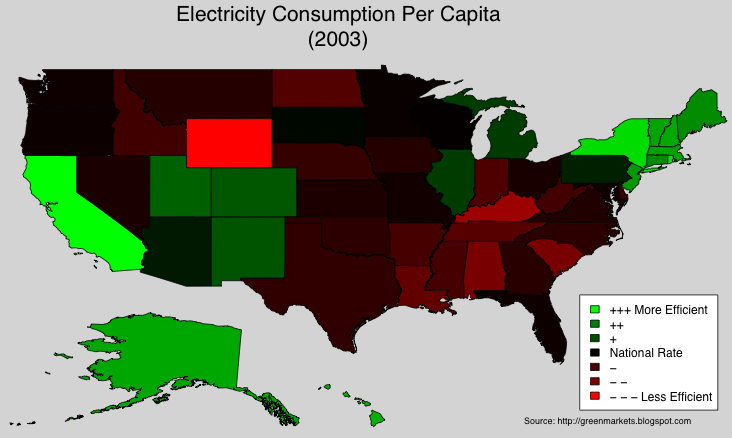
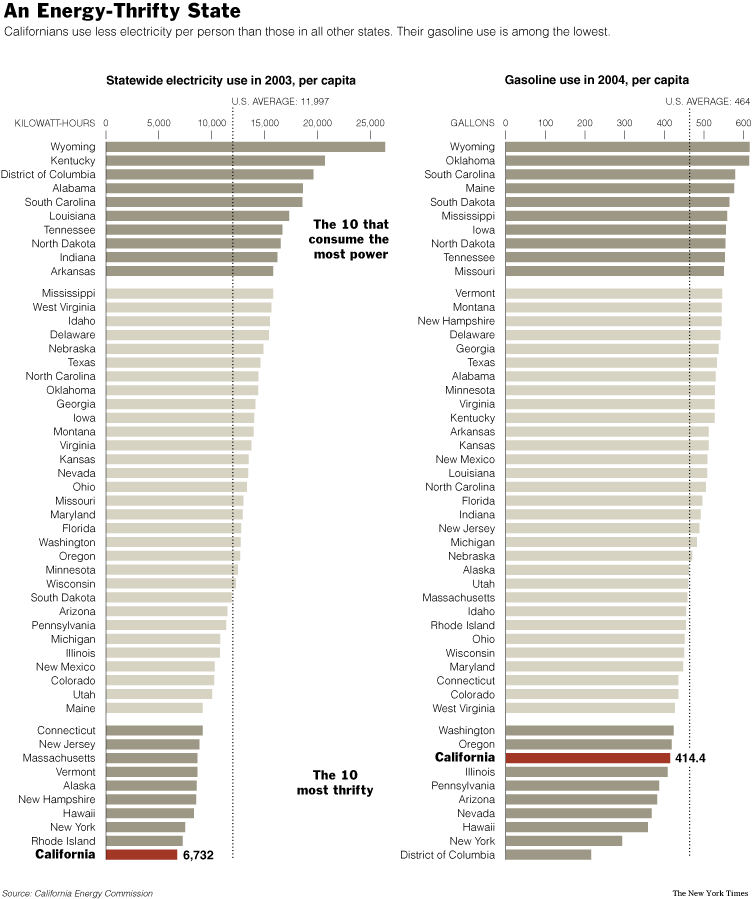
I have consistently argued that Conservation is something we in the U.S. must do more of. We need technologies to produce "clean" energy, AND technologies that drastically reduce the amount of energy we use. Ideally, we would combine technological advances with voluntary reduction in consumption. In a previous post, I highlighted the states that consumed the least amount of electricity per capita:

Besides being blessed with great weather, California is also the one state were bipartisan consensus has led to longstanding conservation programs.

Coal Industry Awakens
Exploiting calls for "energy independence", the coal lobby is pushing coal as another domestic fuel source. A recent article in the Wall St. Journal (subscription required) touched on the critical need to consider global climate change as part of any energy solution:
... Greater use of liquid fuels made from coal, the nation's most plentiful energy source, would reduce reliance on imported oil. But making the liquid fuels and burning them in automobile engines would release additional carbon dioxide, a greenhouse gas thought to accelerate climate change, environmentalists say.
... David Hawkins, a climate-change expert for the Natural Resources Defense Council, says the diesel fuel still contains carbon dioxide, which will be released into the air when it is burned in the engines of cars and trucks. "This issue is the classic example of why you need to have an integrated policy on both global warming and energy," he says.
Finally, to understand the importance of coal in the 2008 Presidential Elections, we note that the swing state of Ohio, and Iowa (the home of the first primaries) have a lot of coal reserves:


Digg It! , Bookmark to del.icio.us , My Yahoo! , ATOM Feed