Showing posts with label whole foods. Show all posts

Monday, January 15, 2007

Holy Mackey: Whole Foods Reader Comments

Whole Foods Market CEO John Mackey started blogging in September 2005, and while I counted only 9 posts, they are all thoughtful and well-written. Equally interesting are the comments left by readers of his blog. Are there particular topics that emerge as important to the blog's readers?

Reprising an earlier post, I used recent developments in (unsupervised) machine learning and bayesian computation. These new techniques allows one to analyze text data, uncover latent topics, and measure the relative sizes of the topics. I was able to identify 473 comments, from the 9 blog posts. While the number of comments is relatively small for an algorithm of this type, I decided to forge ahead and see if what type of results I would get. Using this text mining algorithm, I uncovered 25 topics/subjects from the readers' comments.


As usual, to enlarge an image, click on it. If the topics where equally sized, one expects about 4% of the words found in readers comments to be devoted to each of the 25 topics. Interestingly, the Top 10 topics (in blue) were those with size clearly above the benchmark 4%. For completness, I included some other smaller but notable topics (in yellow).

Not suprisingly, the most popular topic was locally grown and organic food. Related topics include, Michael Pollan's recent book and sustainable agriculture: combined these 3 topics accounted for about 1 in 7 words found in the readers comments. Another popular subject centered around alternatives to purely profit-driven models of business ("good corporations", "the business world and company purpose", "social responsibility", "new capitalism"): these three topics accounted for about 1 in 7 words found in the readers comments. Animal Welfare, as represented by the lower ranking topics, "treatment of animals" and "organic dairy and farms", combined to account for about 1 in 14 words found in the readers comments. Topics that address Whole Foods culture ("team members and culture", "people and vision", "stock and investors", "company/leadership") accounted for about 1 in 6 words found in the readers comments.

SUMMARY: CEO John Mackey's blog elicited comments touching on some of the most interesting (green) topics of the day. Such serious exchanges, provide yet another sign that Whole Foods is different from other large corporations. Can you name another major public company with a CEO who blogs and generates responses which address these topics?

Monday, December 04, 2006

Organic Food Sales and Whole Foods Market

Once can cite a litany of anecdotal evidence showing that sales of Organic Foods in the U.S. is growing fast. For official statistics, the Organic Trade Association conducts regular manufacturers survey, which unfortunately, seems to be available only to members. I was able to track down a copy of the 2004 survey, and what follows are some graphs I've put together using the 2004 survey results. (To enlarge a particular image, click on it.)

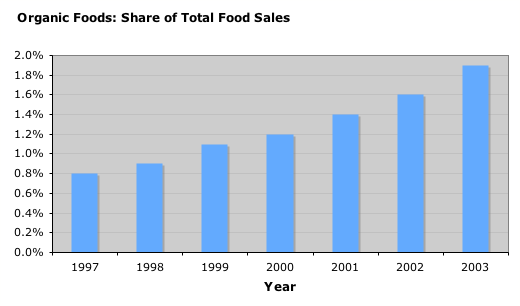
One measure of growth is the increasing share of Organics in overall food sales: from 1997 to 2003, the share of Organics rose from 0.8% to 1.9%, a 138% rise.


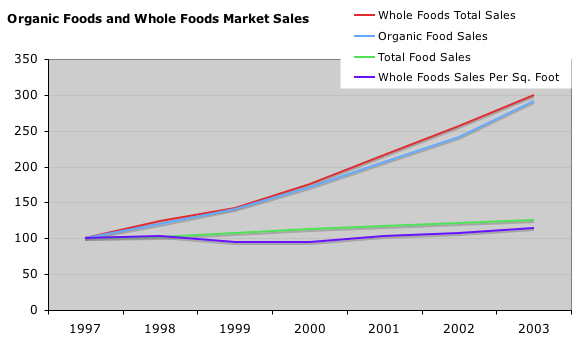
Another way to illustrate the growth in Organic Foods is to graph the time series of sales of Organic Foods and all foods. The problem with drawing the graph of these two time series is that the magnitude of the two time series are very different: Organic Food Sales are a small proportion of total food sales. A common trick is to normalize both time series so they start at a common initial value (say 100), then use their respective year-over-year growth rates to plot the rest of the graph. In the graph below we plot 4 times series in this manner:


The total sales of Whole Foods Market (organic and conventional, food and non-food items) closely tracks the sales in Organic Foods. The high correlation reflects the importance of Whole Foods within the Organic Foods industry, and the importance of Organic Food sales to Whole Foods' total sales. What the graph suggests is that a rough estimate of the year-over-year growth in Organic Food sales, is the growth in Whole Foods' total sales.

Between 1997 and 2003, Whole Foods sales went up 200%, compared with a 191% growth in Organic Foods. Because of its scale and efficiencies derived from its size, one expects Whole foods to grow slightly faster than the Organic Food industry. If one factors in the growth in Whole Foods retail stores (sales per square foot), Whole Foods grew a more modest 14%. Total food sales grew 25% between 1997 and 2003.

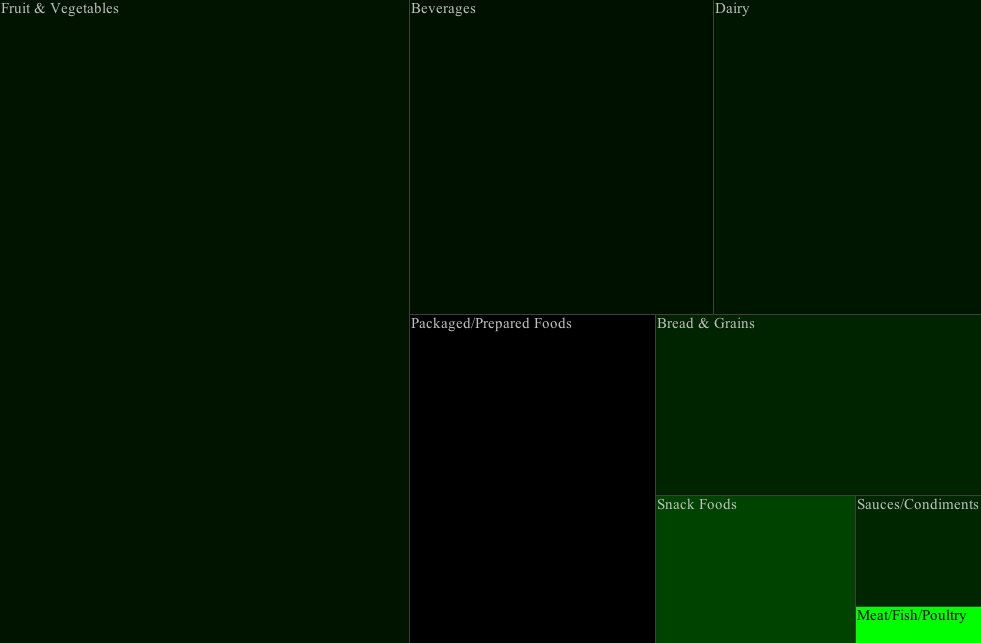
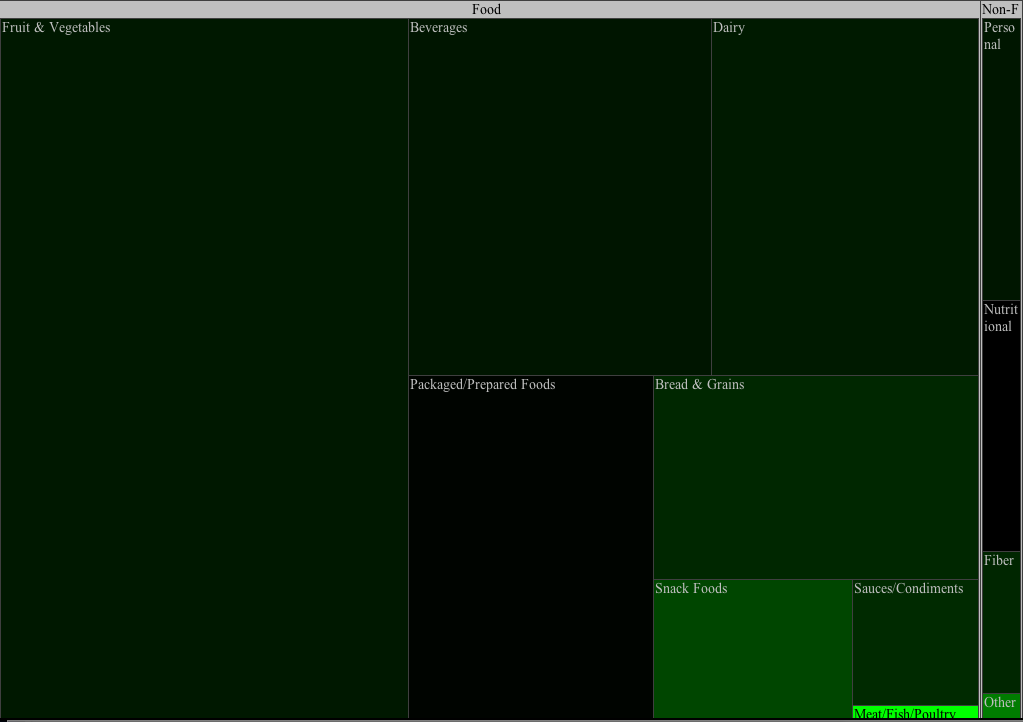
The remaining graphs are drawn from the sales of Organic items in 2003. Which categories are growing the fastest? To address this question we use a treemap. In a treemap, the size of the square reflects the size of the category, while its color reflects the rate-of-change of the category. Green means a category is growing, Black means it is relatively flat, Red means the category is declining. In the following treemaps, the size of a square reflects the 2003 sales in the given category, the color corresponds to the 2003 year-over-year growth. (To enlarge a particular image, click on it.)


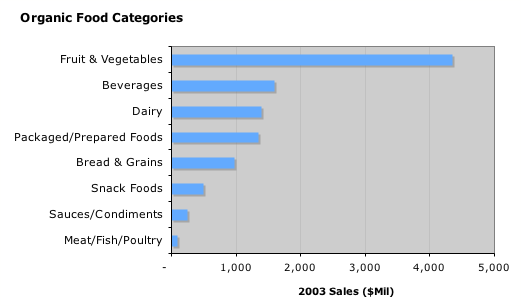
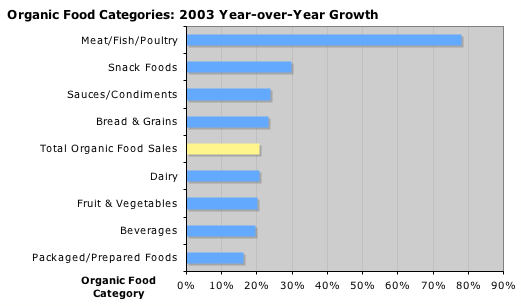
Not suprisingly, the smallest category (Meat/Fish/Poultry) grew the fastest. The advantage of a treemap is that you can encapsulate two pieces of information in one graph: the size of a category and its growth rate. The alternative approach is to use two separate bar charts:


Here is a treemap for the Organic Non-Foods categories:


Finally, here is a 2-level treemap of Organic Foods and Non-Foods, to show the relative sizes and growth rates of all the categories:


Conclusion: Organic Foods sales are growing much faster than sales of non-organic food products. The share of Organic Foods in overall foods sales more than doubled between 1997 and 2003. Whole Foods Markets total sales, closely tracks the total sales of all Organic Foods: an estimate for the year-over-year growth in the sales of Organic Foods, is the corresponding change in the Total Sales of Whole Foods Market.

Monday, November 27, 2006

Whole Foods Locations

Whole Foods is the big player in Organic groceries, and arguably, for the entire LOHAS Industry (Lifestyles of Health and Sustainability). I will be devoting some future posts to understanding Whole Foods. With a market cap of $6.7B and no signs of slowing down, Whole Foods has tried to stay true to its values, inspite of its rapid growth.

To understand the market for Green products, it is good to know how Whole Foods selects it's store locations. Whole Foods stores tend to be located in upper income, liberal leaning enclaves. As green products become more mainstream and affordable, will we see Whole Foods expand beyond their current geographic areas?

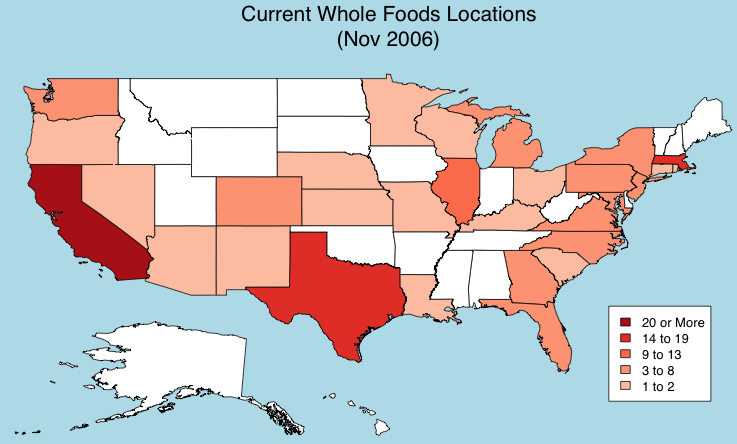
Here is a map of Whole Foods stores in the mainland U.S. I aggregated stores by county: LA county has the highest number of Whole Foods stores. (To enlarge, Click on an image.)


One can also aggregate the number of active locations by State:


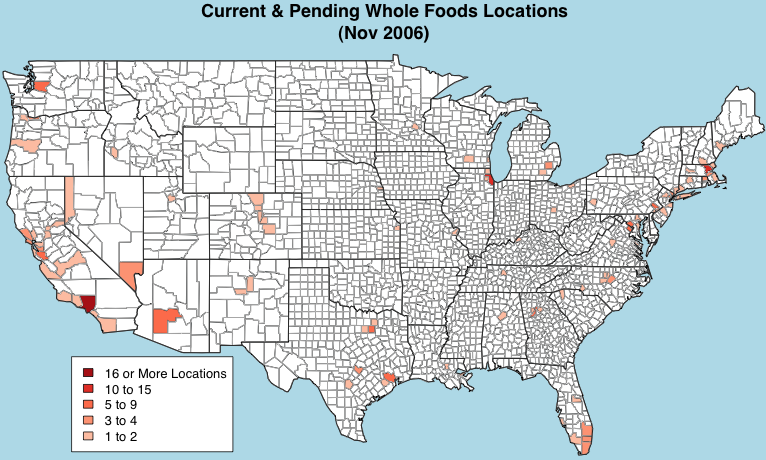
In these next maps I added stores currently in development. The first graph is an aggregate at the county level, and the second graph is an aggregate at the state level:


Illinois is joining Texas and Massachusetts with just below 20 active and pending locations, most of the stores serve the Chicago metro area. California is far and away their biggest market, further cementing the state's reputation for being at the leading edge of lifestyle trends.

At this time, Whole Foods is expanding carefully, and is generally sticking to the same metro areas. The market for organic foods is growing, and I have to believe there is an opportunity for someone to capture this market in the states & metro areas that Whole Foods is currently ignoring. Will Wild Oats dominate, or will the "mainstream" grocery chains slowly capture the market for Organic foods, in these other regions? From a logistics and distribution POV, the mainstream grocers who are already in these regions can easily expand their offerings of Organics foods. So how does Whole foods keep growing at a rate to make its investors happy? I think their strategy is clearly to keep adding to their current locations, and to take advantage of their scale and distribution centers.